Our project
Project Vision
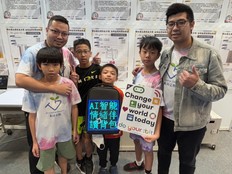
In response to global climate change and carbon emission challenges, this project centers on the theme "Low Carbon Living: Your Actions Change the World." By leveraging AI and Internet of Things (IoT) technologies, we have developed a smart campus solution that integrates energy saving, carbon reduction, and environmental education. This technology-assisted approach encourages students and faculty to practice a "Net-Zero Green Lifestyle," aligning with UN SDGs Goal 7 (Affordable and Clean Energy) and Goal 12 (Responsible Consumption and Production) to work toward a sustainable future.
Core System Modules
The system is designed around four key modules:
AI Recycling Recognition System: Uses a model trained via Teachable Machine to assist students in real-time waste classification.
Smart Energy-Saving Lighting: Employs micro:bit sensors to detect human activity and automatically toggle lights.
Intelligent Temperature Control: Automatically activates or deactivates fans based on temperature sensors to simulate energy-efficient air conditioning usage.
Solar Tracking System: Automatically adjusts the angle of solar panels to maximize power generation efficiency.
Data Monitoring and Smart Management
Sensor data from all systems—including temperature, light levels, voltage, current, and recycling frequency—are transmitted via Bluetooth to an iot:bit and uploaded to the ThingSpeak cloud platform for real-time monitoring and analysis. When the system detects anomalies or reaches predefined thresholds, a Python-based automation script immediately sends a LINE notification to administrators, ensuring effective smart management and energy monitoring.
Educational Impact and Sustainability
We created this project because we believe that big changes start with small, daily actions. By combining AI and IoT technology, we want to turn our school into a smart, green campus where saving energy and recycling isn't just a duty, but a natural part of our lifestyle.
Our inspiration
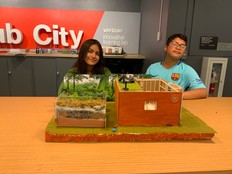
Constructed using eco-friendly recycled materials, this project balances educational value with practical utility. It fosters environmental awareness and sustainable action among students while driving green transformation on campus. This project serves as a model for building a smart, sustainable educational environment.